.

.

Stuff and Nonsense

Showing posts with label Canadian authors. Show all posts

Friday, April 3, 2020

Please welcome special guest Marty Chan!


Marty Chan writes books for kids and plays for adults. In theatre, he’s best known for his hit plays, Mom, Dad, I’m Living with a White Girl and The Bone House. His kids books range from True Story, a funny picture book about his stressfarting cat to his steampunk fantasy trilogy, The Ehrich Weisz Chronicles. Marty’s latest book, Kung Fu Master, is available online and in bookstores. He works and lives in Edmonton with his wife Michelle. 


Writing tips for people looking for something to do during the Coronapocalypse


When I was starting out as a writer, experts would tell me again and again, “write what you know.”

Great advice… Unless you’re barely in your twenties and what you know is that D&D is your jam. While I’d be happy to share my notebooks of paladin adventures and gelatinous cube attacks, I thought it would be better if I stuck to writing advice that is less reliant on 20-sided dice and more practical.

First off, writing for yourself is awesome. With limitless imagination, anything is possible. When I worked with little kids, I was always amazed at their creativity. Talking unicorns led heroes into a world where rivers of chocolate never ran dry and stars were made from expired Pop Rocks. Of course, the kids were less concerned about structure, but who cared when the moon could randomly drop from the sky and crush any obstacle that stood before our hero? 

Revise, Revise, Revise 


Once you have a first draft, however, the real work begins. I’m going to use the dreaded ‘R’ word… Revision. Yes, writers revise. It’s part of the job. Some authors revise after they have their first draft completed, while other authors rework their story as they write their initial draft. No one method is better than the other, but the key is to go over your manuscript to make sure that the story works both for you as the writer as well as your reader.

Try this as an exercise. Tell a story to yourself. Then tell the same story to a friend. I’ll bet that how you tell the story to your friend will change based on how they respond to the story. That’s what revision is—adjusting your story to reach the reader. Yes, you might deviate from the original story, but to paraphrase a line from Casablanca, “You’ll always have your first draft.”


Trouble should be your story’s middle name

Where stories tend to get "flabby" is the same place those of us who fail to keep our New Year’s resolutions go flabby—the middle. The reason for this is a lack of conflict. As writers, we’re so focussed on setting into motion the events that we forget that the story gets interesting when our best laid plans go off the rails.

When I get to the middle, I always ask myself how can I get this character into trouble. And once I come up with a problem, I tell myself that I can come up with something better. In real life, most of us try to avoid trouble, which is why often times our fictional problems are so tame. We have to turn off the part of us that wants to get along with others and hurl our protagonists into the deep end of the pool. Yes, I know this makes it harder for you to rescue your character from her problems but trust me, more trouble makes for a far more interesting journey for the reader.


WOW your Readers

There are three things that have steered me in the right direction when I create conflict.

1. What does my character want? If I know their objective or goal, it gives the story a           direction to go.

2. Obstacles: Think about what or who can get in the way of your character’s mission.         External obstacles like objects and other characters will shape the story, but don’t forget       emotional/internal obstacles. They will develop your character.

3. Why does your character want to do all of this? Knowing the character’s motivation helps to solidify who your character is and makes them relatable to your readers.

Having WOW playing in the back of your head as you write will always help you create the kind of conflict readers want in a story. Just remember, trouble is your story’s middle name. 


Writing Lessons for Kids

Check out these YouTube videos for kids who want to write but need some guidance.

What does a Rubik’s Cube have to do with Writing? https://www.youtube.com/watch?v=NM6l44H6V64&t=5s


How to make setting come to life? https://www.youtube.com/watch?v=UVviZzfQVTg&t=11s

How do you tackle a first draft? https://www.youtube.com/watch?v=JJ50wOPLslw&t=1s

Want to hear from other Canadian kids authors?  https://voiced.ca/project/i-value-canadian-stories-the-podcast/


My thanks to Marlyn for lending me the space on her blog to share my thoughts on writing. If you’re interested in any of my books, please check out my website: www.martychan.com.


Marty Chan writes books for kids and plays for adults. In theatre, he’s best known for his hit plays, Mom, Dad, I’m Living with a White Girl and The Bone House. His kids books range from True Story, a funny picture book about his stressfarting cat to his steampunk fantasy trilogy, The Ehrich Weisz Chronicles. Marty’s latest book, Kung Fu Master, is available online and in bookstores. He works and lives in Edmonton with his wife Michelle. 


Monday, November 23, 2015

2015 Aurora Awards


The Aurora Awards are presented by the Canadian Science Fiction and Fantasy Association  to honour the best of Canadian science fiction and fantasy literary works, artwork, and fan activities from the previous year. 


Best English Novel:  
A Play of Shadow by Julie E. Czerneda, DAW Books

Best English YA Novel (TIE): 
Lockstep by Karl Schroeder, Tor Books
Out of This World by Charles de Lint, Razorbill Canada


Best English Short Fiction: “Crimson Sky” by Eric Choi, Analog, July/August


Best English Poem/Song: “A Hex, With Bees” by Tony Pi, Wrestling With Gods: Tesseracts Eighteen, EDGE


Best English Graphic Novel: It Never Rains by Kari Maaren, Webcomic

Best English Related Work: On Spec published by the Copper Pig Writers’ Society


Best Artist: Dan O’ Driscoll, covers for Bundoran Press and On Spec magazine


Best Fan Publication: Speculating Canada edited by Derek Newman-Stille


Best Fan Music: Kari Maaren, YouTube Channel


Best Fan Organizational: Sandra Kasturi, Chair, Chiaroscuro Reading Series: Toronto


Best Fan Related Work: Derek Newman-Stille, Speculating, Canada on Trent Radio 92.7 FM


Wednesday, September 30, 2015

A Small-Town City

by special guest Janice MacDonald.


This book is a strange wee beast, a combination of my first foray into writing mysteries and my latest, seventh puzzle with my amateur detective, Randy Craig, MA. The impetus was to bring that first, long unattainable adventure back into readers’ hands while at the same time giving them the heft and style of the series they had come to know. So, in the magical worlds of the mysterious, one plus seven equals six!

Sliding back into the world of The Next Margaret, that very first mystery, has hauled up a fair amount of nostalgia for me. Like Randy, I was back at university, doing an MA, after being out in the freelance world for four or five years. I was already living in the sweet apartment she later moved to within a cinnamon bun’s toss of the Highlevel Diner, but I made her suffer through the basement suite I had lived in during my second year of undergrad. Having researched and written a thesis on detective fiction for my MA, I figured I would try my hand at creating a reluctant amateur in the farceur style with the closed world of grad studies and TA-ing and sessional lecturing not as familiar to mystery readers already well versed in the academic novels of full professors and Oxford dons. In fact, one reviewer remarked that, “Randy Craig mysteries were like Amanda Cross for the untenured set.”

More than the puzzle, more than the charismatic detective, more than the grit or the laughs or the meanness of the streets depicted, what matters in a detective series is the location. In a formulaic genre, the bones of the book are already known, so it’s not that they’re reading for stunning plot structure. And while they need to identify with the detective and befriend him or her, they don’t necessarily want too much change in personality. So what it comes down to is that people read mysteries for an entry into a world with which they are not intimately familiar – and mystery novels take them to New Mexico, or Norway, or Watts in the late ‘50s, or post-Crimea War London. I thought, why not Edmonton?

The beauty of setting a novel here was that, up on the 53rd parallel, we were the most northerly major university city, with all the amenities of a large metropolis, yet a small town feel. We had a vibrant arts scene, a symphony, an opera company, amazing theatre, festivals galore, loads of intellectually stimulating people, grassroots blue collar grit, a glorious river valley and an ominous black bridge spanning half a mile. Running through the ravine system were deer, coyotes, the odd moose, cougars, even a bear was spotted the other day in Emily Murphy Park. And amazing as it seemed, relatively few people had ever heard of us.

They might have heard of us if they followed hockey, or if they were British and of a certain age, since all their sisters seemed to end up as Princess Patricia war brides. But they didn’t tend to read about us. We popped up from time to time in a quick chapter of a Dick Francis novel, a glancing reference in a Jeopardy question, a garrulous condemnation in Mordecai Richler magazine piece. The world was ready for Edmonton, and most particularly southside, campussy Edmonton. They would be lining up for Randy Craig Mysteries.

I quite honestly figured it would be a cakewalk. I would write a mystery series featuring a funny, mouthy brunette, set her in various milieus connected to the University of Alberta, and let her bring Edmonton to the world. After all, mystery readers crave new series. I know I do; I count myself right up there with obsessive readers the world over.

And the series does sell relatively well in Edmonton where people are sort of bemused to find their real street names in fiction. They sell even better all across North America now that people can buy them easily on e-readers. Adjunct lecturers love Randy, and so do librarians. And while there has been no British distribution deal, or TV producers with wheelbarrows full of cash so far, recognition does grow with every new adventure. Hudson’s Bay Company cartographer Peter Pond put Edmonton on the map. Randy Craig is satisfied with just sticking a small pin in it.

Still, with every new book comes more awareness, and even as I look back over thirty-seven years of writing and twenty-two years of Randy Craig in print, I am looking forward, as well, to think about what she might be getting up to as she moves firmly into middle-age. Not sure what number we’ll get to, she and I. But whatever happens, you just know that things won’t add up.


Janice MacDonald is the author of eleven books, including novels, non-­fiction titles, and a children's book. She has been widely anthologized, and her popular Randy Craig novels were the first mystery series set in Edmonton. Janice has taught English literature, communications, and creative writing at both the University of Alberta and Grant MacEwan College. She currently works for the the Government of Alberta. Born in Banff, Alberta, Janice lives and writes in Edmonton and considers herself to be a quintessential Albertan.


Wednesday, February 11, 2015

Welcome guest blogger Janice MacDonald!

Photo credit: Arif Kassam
How did Randy Craig come to be?

I had gone back to university to do an MA in English, with a focus on detective fiction and popular culture.

I remember quite clearly sitting in the grad lounge, reading some lovely trashy paperback novel like The Maltese Falcon or The Night The Gods Smiled, when some person up to their armpits in Chaucer and Derrida said, “So now I suppose you’re going to write a mystery novel, are you?” and I responded, “Yes, I suppose I am.” I had been out of school for a while, and had already written a couple of local history books and some radio plays at that time, but I don’t think till that moment happened, I had seriously considered writing a mystery series.

But, there I was -- committed. And they do say to write what you know. So the idea of a grad student coming back to do an MA, after having been out in the freelance world a while seemed a natural row to hoe. Randy’s return to academe had been because she had found a brand new writer to study and base her thesis on, but what about people who wanted to create an academic life around Shakespeare or Samuel Beckett? 

At just about that time, I had friends in Genetics who had been told their research was only going to net them M.Sc. degrees rather than Ph.D.s, because it was negative findings, and no journal would publish their work. Scientists all know that negative findings can be just as valuable as positive ones, but there is an element of a rat race in everything, right? So, the whole idea of looking at what people would do to make it in academe came about, and with that came the start of a series.

It had to be set in Edmonton. Nothing was set in Edmonton, and I figured we needed to correct that. I’d also done an interview of L.R. Wright who said she had really had to fight to get her series set in Sechelt, B.C. I just thought it was about time we owned up to existing. Detective fiction requires location to be a main feature of the work, too. Character and location is really what draws people back to a series time and again. It’s been a wonderful thing to become an ambassador for my city to the world, and readers here in Edmonton still find it fun to see their own streets becoming a bit “mean.”

Her name, Randy, is short for Miranda, of course, one of Shakespeare’s true naïfs, who has to learn who to trust and who not to trust in her “brave new world.” But another reason for the androgynous nickname was to fit into the tradition that was building in female detective fiction, which I had just been writing about in my thesis. With that either/or name or those initials, the reader can believe the character to be somewhat of a tomboy, and therefore probably better able to hold her own in a physical altercation. She also has the potential of getting the drop on someone once in a while, if they think they are coming to meet a man.

The trouble is, between the publication of my first and second book, I met and married a lovely man named Randy, which gets people who are just meeting us all confused for a bit. I am surrounded by Randys now. 

And I wouldn’t have it any other way!


Janice MacDonald lives in Edmonton.  She writes for the government during the week and mystery novels on weekends.


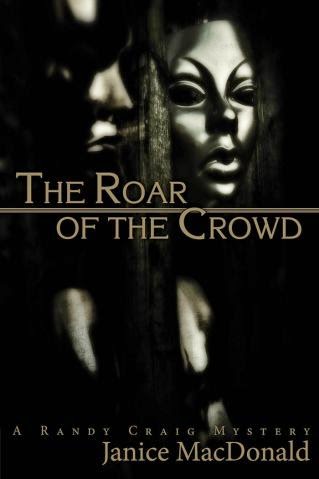
The Roar of the Crowd is part of The Deadly Medley Sweepstakes at Criminal Element!  For your chance to win — and to learn more about the latest and greatest in crime fiction — just click here before February 17.